
Counterfeit vape hardware is common, and unlike a fake handbag, the downside here is not cosmetic. A counterfeit battery is a lithium cell of unknown origin with no protection circuitry, assembled with cheap solder, sitting in your pocket.
Here is what actually matters and how to check it.
Why it is worth thirty seconds of your time
Three real risks, in order:
Uncertified lithium cells. A genuine battery uses a cell with over-charge, over-discharge, and short-circuit protection. Counterfeits routinely skip the protection board entirely because it costs money. That is the difference between a battery that shuts itself off and one that vents.
Lead in the solder joints. Cheap manufacturing uses leaded solder at the 510 connection — the exact point where heat meets the oil you are about to inhale. This is a documented contamination pathway in vape hardware, and it is why serious lab reports test heavy metals on the finished, filled device rather than the bulk oil.
Wildly inaccurate voltage. A dial marked 3.3V–4.8V on a counterfeit may deliver something else entirely. You set it low for rosin and it fires hot anyway, burning a $26 cartridge on the first pull.
The six checks
1. Where you bought it. The most reliable signal, and the easiest. Buy from an authorised retailer. A marketplace listing at a third of the going price, from a seller with no history, shipping from an unspecified location, is telling you what it is.
2. Weight in the hand. Genuine batteries feel dense because the cell inside is real. Counterfeits are noticeably light. If you have handled a real one, a fake feels wrong immediately — this is the check experienced buyers actually use.
3. Print quality on the packaging. Look at the small text, not the logo. Counterfeiters copy artwork well and typography badly. Blurry edges on small print, slightly-off colour, inconsistent font weight, misaligned panels, spelling errors in the fine print.
4. The authentication code. Most legitimate hardware brands print a scratch-off verification code and host a checker on their own site. Scratch it, check it, and confirm the URL belongs to the manufacturer rather than a lookalike domain. A code that has already been used is a strong signal.
5. The threading. Screw a cartridge on. Genuine 510 threading engages smoothly and sits flush. Counterfeit threading is often cut roughly — it catches, cross-threads, or leaves the cartridge sitting at a slight angle. If it does not seat cleanly, that is machining quality, and machining quality tracks everything else.
6. Behaviour on first charge. A genuine battery charges predictably and the indicator changes when complete. A counterfeit may charge unusually fast, run warm, or show no indicator change at all. If a battery gets hot while charging, unplug it and stop using it. That is not a quirk.
If you think you have a fake
Stop using it. Do not keep it on a charger and do not leave it charging unattended.
Dispose of it at a household hazardous waste drop-off or a retailer that takes batteries — not household waste, where crushed lithium cells are a documented cause of fires in collection trucks. Then tell the seller you bought a counterfeit, because the chargeback is usually straightforward and the report matters.
The simplest protection
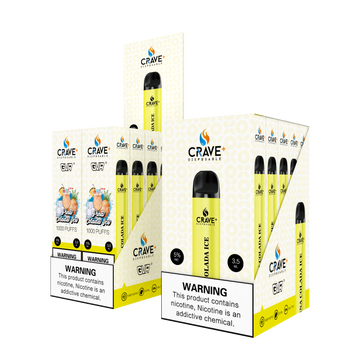
Buy hardware from somewhere that stands behind it. Ours is the Crave 1100mAh Slim Twist at $13 — and if one fails inside its first week of normal use, tell us and we will replace it. A counterfeit saves you a few dollars once and costs you a cartridge, or worse.
The same instinct applies to what goes in the cart. Our guide to reading a lab report covers spotting a faked COA, which is the same problem one layer up.
For adults 21 and over. These statements have not been evaluated by the Food and Drug Administration.